






























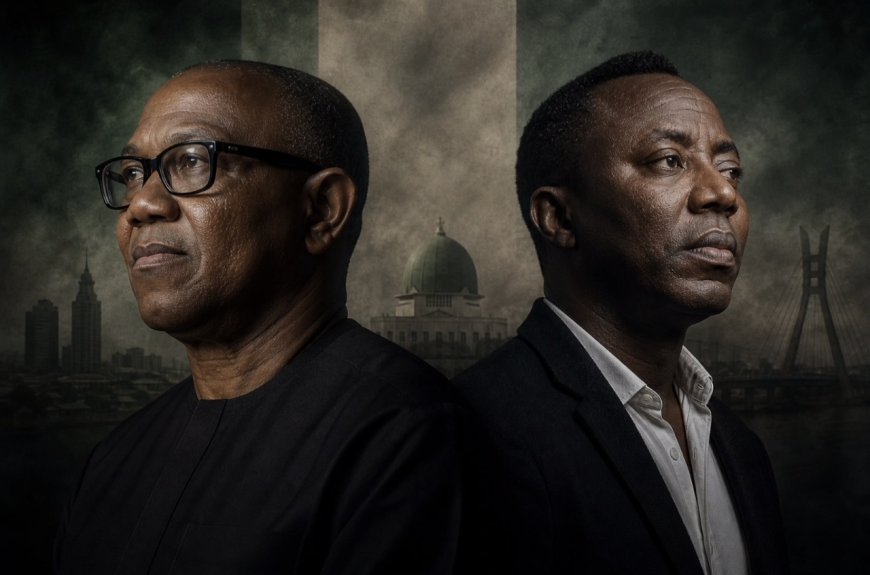
Sowore vs Peter Obi: Two Different Visions of Change in Nigeria
This article explores the contrasting leadership visions of Peter Obi and Omoyele Sowore—one believes Nigeria can be repaired from within; the other believes the system must be confronted.
Prefer listening? Tap play and the article will be read aloud.
Nigeria is a country permanently searching for change.
Every election cycle, every fuel price increase, every corruption scandal, every wave of insecurity, and every economic downturn eventually pushes Nigerians back to the same emotional question:
Who can truly fix this country?
For decades, Nigerians have voted for stability and received stagnation. They have voted for strongmen and received fear. They have voted for democrats and received disappointment. They have voted for “experienced politicians” and watched institutions weaken further. The result is a generation increasingly tired of recycled promises and increasingly attracted to alternatives.
Many young Nigerians today no longer suffer only from economic hardship. They suffer from political exhaustion. Graduates roam the streets without opportunities. Citizens survive rather than live. Entire generations have grown up hearing the same speeches about hope while watching corruption evolve faster than governance itself.
It is within this atmosphere that two political figures emerged as symbols of different forms of resistance to Nigeria’s establishment politics: Peter Obi and Omoyele Sowore.
Both men speak to Nigerian frustration. Both represent dissatisfaction with the political order. Both attract citizens who believe Nigeria cannot continue as it is.
Yet beyond surface similarities, they represent two fundamentally different ideas of change.
Peter Obi represents reform, stabilisation, institutional rebuilding, and strategic moderation. Sowore represents confrontation, disruption, ideological resistance, and systemic restructuring.
One believes Nigeria can still be repaired from within.
The other increasingly behaves as though the system itself is the problem.
And perhaps that is why the debate between Obi and Sowore has become more than a political comparison. It has become a reflection of Nigeria’s deeper identity crisis.
What exactly does this country need now?
Another stabiliser?
Or someone willing to fundamentally disrupt the foundations of the Nigerian state?
Reform vs Resistance
To understand the contrast between Obi and Sowore, one must first understand their political psychology.
Peter Obi rose nationally through the language of competence. His appeal is rooted in discipline, prudence, fiscal caution, and technocratic governance. To many supporters, he represents calm leadership in a chaotic political environment. He speaks the language of production, investment, accountability, and measurable governance.
His supporters often describe him as rational, humble, and focused.
Sowore, by contrast, emerged through activism and confrontation. Long before becoming a presidential candidate under the African Action Congress, he built a reputation as one of Nigeria’s loudest anti-establishment voices. His #RevolutionNow movement and repeated confrontations with the Nigerian state reinforced his image as a politician willing to absorb pressure publicly rather than soften his rhetoric for elite acceptance.
Where Obi sounds managerial, Sowore sounds revolutionary.
Where Obi seeks institutional correction, Sowore seeks institutional disruption.
This difference is not cosmetic. It affects how both men respond to conflict, power, governance, and political survival.
At the heart of the Obi-Sowore divide lies a deeper philosophical question:
Can Nigeria still be gradually reformed, or must it be fundamentally restructured?
Obi appears to believe that despite Nigeria’s dysfunction, the country’s institutions can still function if managed properly. His approach suggests that discipline, efficiency, accountability, and economic restructuring can gradually restore confidence in governance.
This is why his messaging consistently focuses on:
- cutting waste,
- improving production,
- supporting SMEs,
- stabilising the economy,
- and strengthening governance systems.
His politics is rooted in stabilisation.
Sowore, however, represents a different emotional and political energy. His politics emerges from the belief that Nigeria’s problems are too deeply embedded for cautious reform alone. To him and many of his supporters, corruption is not an accident within the system — it is part of the system itself.
That distinction matters.
Because if the system itself is fundamentally compromised, then administrative competence alone may not be enough to save it.
This is why Sowore’s language is often sharper, more confrontational, and less accommodating toward elite political culture. His politics is rooted not in gradual correction, but in structural challenge.
In simple terms:
Obi wants to rescue the Nigerian system. Sowore wants to confront the foundations holding it up.
The Crisis of Nigerian Leadership
One of the strongest ways to compare leaders is not through campaign speeches, but through how they behave under pressure.
And this is where the contrast between both men becomes especially visible.
Sowore has consistently demonstrated a higher tolerance for direct confrontation. Whether facing arrests, state pressure, or political isolation, he has repeatedly positioned himself as someone willing to absorb conflict publicly. His arrests by the Department of State Services and his continued activism after detention strengthened his image among supporters as a politician willing to fight entrenched power regardless of personal consequences.
His politics thrives in resistance.
This creates a perception of courage and ideological consistency. Even critics often acknowledge that Sowore rarely softens his message for elite approval.
But confrontation has its limitations.
Governance is not only about resisting power; it is also about coordinating institutions, negotiating competing interests, building alliances, passing legislation, and maintaining national stability. A leader can be morally courageous yet still struggle with the practical mechanics of governing a deeply fragmented state.
Obi operates very differently.
His instinct is often conciliatory rather than confrontational. During internal tensions within the Labour Party, he generally avoided escalating factional battles publicly. Rather than dominate the conflict aggressively, he appeared to prioritise political stability and broader coalition management.
To supporters, this demonstrates maturity and restraint.
To critics, it raises questions about political toughness.
And this criticism intensified after a statement credited to Obi circulated widely:
“I’ve never stayed where there’s problem. I would rather be the loser and be called a coward than to stay where there’s problem.”
For many Nigerians, especially those frustrated with the country’s endless crises, the statement sounded deeply troubling.
Because Nigeria itself is a problem.
A massive one.
Can a Non-Confrontational Leader Truly Reform Nigeria?
This question may become one of the defining political debates surrounding Obi’s leadership image.
Critics interpret the statement as evidence of conflict avoidance. They argue that Nigeria’s presidency is not a space where one can simply leave difficult environments. The office demands prolonged engagement with corruption, sabotage, elite resistance, insecurity, and institutional dysfunction.
Nigeria is not a clean corporate restructuring exercise.
It is a battlefield of competing interests.
From this perspective, a leader who exits political conflict may struggle to survive the realities of Nigerian governance.
This is where many Nigerians find Sowore more emotionally convincing. His political style signals endurance in confrontation. He appears psychologically prepared for sustained conflict with entrenched interests.
And in a country where many citizens believe the political elite cannot be negotiated with politely, that image carries enormous appeal.
Yet the counterargument is equally important.
Supporters of Obi would argue that Nigeria’s problem is not a shortage of fighters. The country has experienced decades of aggressive rhetoric, military influence, strongman politics, and confrontational leadership styles.
And still, systemic failure persists.
From their perspective, what Nigeria lacks is not necessarily louder resistance, but disciplined governance, institutional thinking, policy consistency, and calm execution.
This is why the Obi-Sowore debate cannot be reduced to “cowardice versus courage.” It is more complicated than that.
It is fundamentally a debate about how change actually happens in fragile societies.
Nigeria’s Political Culture Problem
Part of Nigeria’s difficulty is that its political culture often rewards survival over competence.
Elections are influenced not only by policy, but by:
- ethnicity,
- patronage,
- religious identity,
- emotional mobilisation,
- and elite bargaining.
This environment creates a dangerous contradiction.
Nigerians frequently demand transformational leadership while operating within political structures that resist transformation itself.
The system often absorbs reformers, frustrates idealists, and rewards political adaptability over ideological purity.
This is one reason why revolutionary politics struggles to scale nationally in Nigeria. The political structure itself is designed to protect continuity.
And perhaps that is why the Obi-Sowore debate resonates so deeply among young Nigerians. It reflects two different responses to the same frustration.
One side believes:
“The system is damaged but still repairable.”
The other believes:
“The system itself has become the problem.”
Stability or Transformation?
The frustration driving support for both men did not emerge in isolation.
Since independence in 1960, Nigeria has repeatedly promised transformation without fundamentally restructuring power.
Under civilian governments and military governments alike, Nigerians have heard:
- anti-corruption promises,
- reform agendas,
- economic recovery plans,
- and national unity speeches.
Yet ordinary citizens continue to experience:
- economic vulnerability,
- institutional weakness,
- insecurity,
- unemployment,
- and declining trust in governance.
This history explains why many Nigerians have grown suspicious of the word “stability.”
Because in practice, stability has often meant:
- preservation of elite interests,
- continuation of patronage networks,
- and survival of dysfunctional systems.
And this is where Sowore’s argument gains emotional force.
To many frustrated Nigerians, radical disruption increasingly feels morally justified.
But history also complicates this position.
Nigeria’s most disruptive periods — coups, military takeovers, civil conflict, and authoritarian restructuring — did not necessarily produce cleaner governance. In many cases, disruption simply replaced one elite structure with another.
This is the dilemma Nigeria faces today:
Stability without transformation leads to stagnation. But disruption without institutional capacity can lead to chaos.
Nigeria’s tragedy is that its citizens are often forced to choose between stability without transformation and disruption without guarantees.
The Limits of Leadership
Perhaps the greatest mistake Nigerians make during elections is assuming leadership alone can solve deeply structural problems.
The reality is harsher.
Nigeria’s crisis is sustained by:
- entrenched patronage systems,
- weak institutions,
- elite capture,
- ethnic political mobilisation,
- inconsistent rule of law,
- and economic dependence structures.
This means even a well-intentioned president can become trapped inside incentives larger than personal morality.
This is important when comparing Obi and Sowore.
Because the real question is not simply:
“Who is more sincere?”
The deeper question is:
“Whose leadership model can realistically survive and transform Nigeria’s political structure?”
Sowore’s challenge is scalability. His ideology inspires strong conviction, but Nigeria’s political system still heavily rewards coalition-building, patronage management, and institutional negotiation.
Obi’s challenge is different. His moderation makes broader acceptance easier, but moderation also risks accommodation with the very structures Nigerians want dismantled.
Both approaches contain risks.
What Does Nigeria Actually Need Now?
This is where the debate becomes uncomfortable.
Nigeria clearly needs deeper reform than cosmetic stability. Millions of citizens no longer believe minor adjustments are enough. Economic hardship, youth frustration, and institutional distrust have created growing demand for structural change.
But countries do not transform emotionally. They transform institutionally.
And institutions do not survive unlimited shock.
This is why the real challenge may not be choosing between Obi and Sowore as individuals, but understanding sequencing.
Nigeria needs:
- stabilisation,
- and restructuring.
It needs:
- institutional discipline,
- and systemic courage.
It needs:
- governance competence,
- and pressure against entrenched power.
The tragedy is that Nigerian politics often forces citizens to choose one at the expense of the other.
The Deeper Meaning of the Obi-Sowore Debate
In many ways, the Obi-Sowore debate reveals a country psychologically divided between fear and frustration.
Fear of collapse.
Frustration with stagnation.
Obi speaks to Nigerians who believe the country can still be rescued through disciplined governance and institutional repair.
Sowore speaks to Nigerians who believe the system itself has become too compromised for gentle reform.
Neither position emerged from nowhere.
Both are products of Nigeria’s long political disappointments.
And perhaps that is why this debate continues to resonate so deeply among young Nigerians. It is not just about two politicians.
It is about two competing visions of national survival.
Conclusion
Nigeria may eventually discover that neither pure stabilisation nor pure disruption is enough on its own.
A country this fragile cannot survive endless instability.
But a country this wounded also cannot survive endless cosmetic reform.
This is the difficult space Nigeria now occupies.
Peter Obi represents the hope that competence and institutional discipline can gradually restore the country.
Omoyele Sowore represents the belief that only deeper confrontation with entrenched power can produce genuine transformation.
One seeks to steady Nigeria.
The other seeks to remake it.
And perhaps the real national question is no longer:
“Who is right?”
But rather:
“What kind of change can Nigeria survive — and what kind can it no longer afford to avoid?”
What's Your Reaction?
 Like
0
Like
0
 Dislike
0
Dislike
0
 Love
0
Love
0
 Funny
0
Funny
0
 Angry
0
Angry
0
 Sad
0
Sad
0
 Wow
0
Wow
0