





























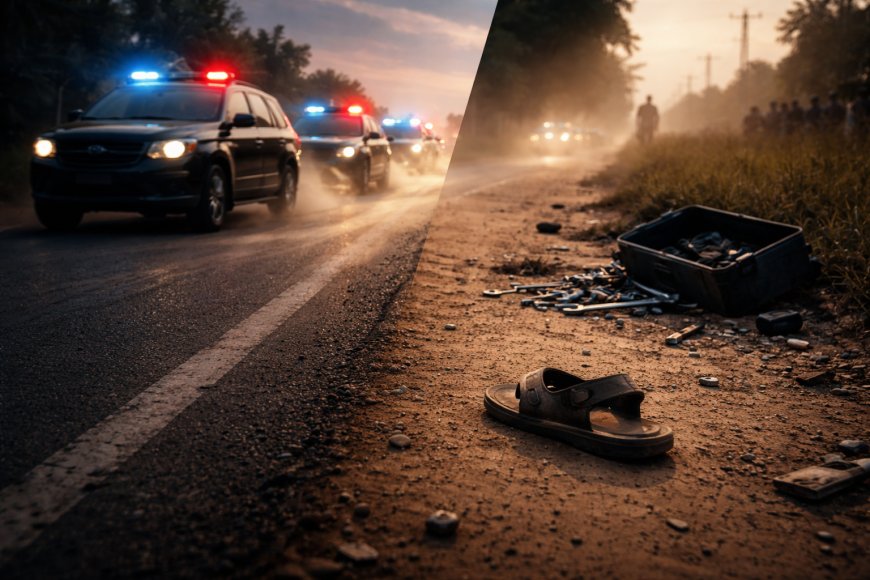
Impunity on Wheels: The Human Cost of Nigeria’s Political Convoys
Nigeria’s political convoys have become more than symbols of power—they are instruments of unchecked privilege, leaving death and devastation in their wake. From Bayelsa to Ondo, innocent lives continue to be lost as speeding motorcades push through crowded roads with little accountability. This piece examines the growing pattern of tragedy, the silence that follows, and the urgent need to confront a culture where authority too often outruns responsibility.
Prefer listening? Tap play and the article will be read aloud.
By Dr. Adejumoke Adeoti
On Friday, April 10, 2026, during President Bola Tinubu’s one-day working visit to Bayelsa State, a vehicle in his motorcade lost control in Obogoro, near the Dr Goodluck Jonathan Bridge. It veered off the road, colliding with a mechanic’s workshop and nearby structures, killing three people: a 17-year-old girl and two adult men. The convoy was heading towards the Angiama-Oporoma Bridge after the president had commissioned projects carried out by Governor Douye Diri. Eyewitnesses reported the rear vehicle suddenly swerving before it was halted by concrete slabs from ongoing bridge construction. Security operatives quickly removed the driver, while police deployed tear gas to disperse the crowd. As of April 11, 2026, neither the Bayelsa State Police Command nor the Presidency had issued an official statement.
This tragedy is only the latest in a long line. In April 2025, seven-year-old Saratu Lawal was killed in Akure, Ondo State, as the First Lady Senator Oluremi Tinubu’s convoy passed through Oba Ile on the way to a Renewed Hope Initiative event. Although the Ondo State Police Command attributed the incident to a hit-and-run driver in a white Lexus rather than the convoy itself, the dispute and public outrage underscored a deeper national problem. A child returning from Arabic school lost her life in the shadow of official power. Whether or not every specific allegation holds, the pattern is undeniable: ordinary Nigerians continue to die in the wake of the very leaders elected to protect them.
A Culture of Impunity on Wheels
Nigeria’s convoy problem is not merely logistical — it is moral, structural and symptomatic of a governance style that prioritises elite convenience over citizen safety. Presidential and gubernatorial motorcades routinely swell to 50, 80 or more vehicles, far exceeding anything seen in established democracies. In June 2024, independent counts documented an astonishing 82 vehicles in President Tinubu’s Lagos convoy. Months earlier, in December 2023, his more than 20-vehicle entourage passed through the bustling Idumota market on Lagos Island, where traders — the president’s own Yoruba constituents — chanted “Ebi npa wa o” (“We are hungry”) in protest as the armoured procession swept past under heavy security.
The culture extends beyond the presidency. In November 2020, a security operative attached to then-House Speaker Femi Gbajabiamila’s convoy shot and killed newspaper vendor Ifeanyichukwu Elechi, a father of a two-week-old child, near Eagle Square in Abuja. Elechi was among a cheering crowd when the motorcade was briefly obstructed. The Speaker confirmed the death and suspended the officer, yet accountability remained elusive. Similar incidents have occurred in Ebonyi, Edo and other states, where gubernatorial convoys have left motorcyclists, pedestrians and students dead.
On the same Bayelsa visit in April 2026, a viral video captured Nigerian Navy and Army personnel trading punches and wielding cudgels in full public view while jostling for position in the presidential escort — an embarrassing spectacle that led to arrests but highlighted the chaos inherent in oversized, poorly coordinated motorcades.
In October 2024, President Tinubu issued a directive limiting ministers, ministers of state and heads of federal agencies to a maximum of three vehicles and five security personnel. He had earlier reduced his own entourage for foreign and local trips. The order was presented as a commitment to cutting the cost of governance and promoting austerity. Yet the reality on Nigeria’s roads reveals a glaring failure to lead by example. Presidential convoys have remained dangerously large long after these directives were issued, exposing the hollowness of top-down reforms that do not bind the highest office itself.
The Mathematics of Waste and Death
The human and financial costs are staggering. Federal Road Safety Corps (FRSC) data for 2025 recorded 10,446 road traffic crashes nationwide, resulting in 5,289 fatalities. Nigeria’s road death rate remains among Africa’s highest. While convoy-specific statistics are under-reported, the pattern from 2005–2013 gubernatorial crashes to recent incidents in multiple states is consistent: recklessness compounded by impunity.
Each oversized convoy consumes fuel, maintenance and personnel at enormous public expense. In 2023, allocations for the presidential fleet, vehicles, and renovations drew sharp criticism amid the removal of fuel subsidies and rising poverty. Multiplied across 36 states, the FCT, and hundreds of officials, this constitutes a de facto subsidy for the political class — funded by the same citizens struggling with inflation, hunger and insecurity.
Internationally, the contrast is stark. The United States Secret Service manages presidential movements with disciplined convoys of roughly 20–30 vehicles, emphasising advance planning and minimal disruption. The United Kingdom has scaled back outriders for greater humility and efficiency. Ghana and other African democracies have trimmed escorts to essentials. India’s Supreme Court has curtailed gratuitous siren use. Nigeria’s approach projects not strength but insecurity and detachment.
What Must Change
The solutions are clear, practical and long overdue. They require political will, legislative action and sustained civic pressure.
First, legislate binding convoy limits. The National Assembly must enact specific laws capping the number of vehicles: no more than 10–15 for the president and vice president (restricted to verified security, medical, and essential protocol staff), five for governors, and three for ministers and speakers. Excess personnel should use low-profile, secure transport. The 2024 presidential directive on ministerial convoys must be revived, expanded, and enforced from the very top, with the Presidency publicly reporting its own convoy sizes for every trip to set the standard.
Second, establish automatic criminal accountability. Any fatality or serious injury involving a government convoy must trigger an immediate independent investigation by a joint FRSC-police task force free of conflict of interest. Involved drivers and officers face automatic suspension and prosecution regardless of status. Mandatory body- and dash-cameras on all convoy vehicles would provide transparency and evidence.
Third, mandate advance route planning and public notification. State traffic agencies and the FRSC must receive 48-hour notices, with mandatory alerts via radio, social media and electronic signs. Road closures should be minimised, with alternative routes maintained. This is standard practice in the US, the UK, and the EU.
Fourth, professionalise and demilitarise convoy operations. Drivers require recurrent specialist training in defensive driving, crowd management and de-escalation. Security personnel must operate under strict civilian use-of-force protocols, not combat-zone mindsets. Investment in intelligence-led protection, community policing, surveillance technology and drones can reduce reliance on large-scale physical escorts.
Fifth, civil society, the judiciary and media must sustain pressure. Litigation in every convoy-related death or injury should make impunity financially and politically costly. A National Assembly bill on “Official Mobility and Convoy Reform,” backed by robust public advocacy, can institutionalise these changes and prevent backsliding.
A Government That Protects Must Not Kill
The most basic test of any government is whether its citizens are safer because of its presence. A state whose convoys kill children on their way from school, crush mechanics at the roadside, shoot cheering vendors, and spark fights among its own security forces has failed that test profoundly.
The Renewed Hope Initiative and similar programmes lose all moral authority when shadowed by such tragedies. Leaders who preach austerity, sacrifice and renewed hope while presiding over unchanged convoy excesses undermine their own legitimacy. The Presidency’s 2024 order offered a promising start; its incomplete implementation represents a missed opportunity that must now be corrected decisively.
Malam Lawali in Ondo State and the grieving families in Bayelsa deserve more than condolences and silence. They deserve a government that investigates thoroughly, prosecutes fairly, reforms boldly and ensures no other parent buries a child because of an official motorcade. Saratu Lawal was seven. The 17-year-old girl in Bayelsa had her whole life ahead. The two men who died with her had families. They all had names. They all mattered.
Nigeria’s convoys must be cut down to size — literally and figuratively. The culture of impunity on wheels must end. The law must finally reach the powerful before more of the powerless pay with their lives. Only then can governance regain credibility and roads become shared spaces rather than killing zones. The blood already spilt on Nigerian highways demands urgent, courageous change. The time to act is NOW!!!
What's Your Reaction?
 Like
1
Like
1
 Dislike
0
Dislike
0
 Love
0
Love
0
 Funny
0
Funny
0
 Angry
0
Angry
0
 Sad
0
Sad
0
 Wow
0
Wow
0