NIGERIAN 2026 BUDGET RUNDOWN: DEBATES AND PUBLIC CONCERNS
A look at Nigeria’s 2026 budget presented by President Bola Tinubu on the 19th of December 2025; Allocations for Education, Security, Health and Infrastructure, revenue estimations and Citizens’ concerns
 Daberechi
CO-WRITTEN WITH MODUPEOLUWA JOAN
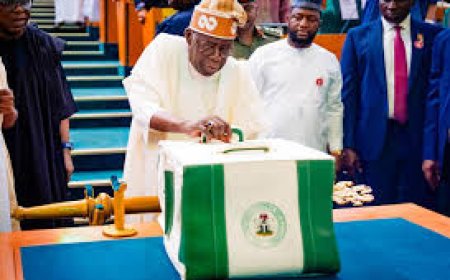
President Ahmed Tinubu presented the 2026 Federal government budget to the National Assembly as a N58.18 trillion spending plan which is built on four clear objectives: consolidate macroeconomic stability; Improve business and investment environment; Promote employment growth and reduce poverty; and strengthen human capital development. The budget lays huge emphasis on the four key sectors of the economy; Defence, Education, Health and Infrastructure. “These priorities (sectors) are interlinked. Without security, investment will not thrive. Without education, productivity will not rise. Without infrastructure, jobs and enterprises will not scale…”, he said.
OVERVIEW OF THE BUDGET
|
|
|
|
Total Budget |
N58.18 trillion |
|
Projected Revenue |
N34.33 trillion |
|
Budget Deficit |
N23.48 trillion |
Table showing key figures: statehouse.gov.ng
The presidents highlight this projection to include a crude oil benchmark at US$64,85 per barrel, an expected production of 1.84 million barrels a day and an exchange rate if N1400 to the US dollar. Capital expenditure is fixed at N26.08 trillion and recurrent (non-debt) expenditure at N15.25 trillion. The budget deficit representing 4.28% of GDP, buttresses ongoing fiscal issues and Nigeria current reliance on debts and fiscal adjustments to finance public priorities. He further adds that these figures are all in an attempt to improve fiscal sustainability and debt transparency.
The 2026 Nigerian Budget Allocation reflects the government's strategic focus on promoting balanced and inclusive economic growth.
National Defence and Security receives a N5.41trillion allocation emphasizing the government’s commitment to battling insurgency, terrorism and banditry across the Northern regions. Budget funds aim to upgrade the modus operandi of the Armed Forces; enable Technology surveillance systems; and cooperate with communities in the process of restoring and ensuring peace in the nation.
Mr. President allocates N3.56trillion to Infrastructural development and Economic Productivity to support Job creation and employment, Agricultural reforms, transport systems development, investments and industrialization in the energy sector,
With the perceived intent to create a more efficient workforce and reduce reliance on import for skilled labour and health care, the federal government dedicates N6trillion to Human capital development with Health and Education receiving N2.48trillion and N3.52 trillion respectively.
PUBLIC DEBATES
The budget has raised loads of questions on transparency, trust and delivery. These speculations are based on issues like debt servicing.
Debt Burdens
Citizens fear that we are caught in an endless loop of debt and debt servicing, estimating from about 15.5 trillion naira to 15.9 trillion naira. More borrowing has increased the worry of the nation’s population though the new tax laws and reforms are a growing headache to the people leaving us to wonder about the future of the nation and its people.
Commentators speculate that rising interest rates and debt sizes will squeeze spending on productive sectors.
Unrealistic Oil Goals
Oil prices per barrel recently dropped to $60.56 which threatens budget implementation of $64.85 benchmark per barrel. Also, Analysts have warned that Nigeria struggles to meet oil production targets which could lead to more fiscal deficit.
Over-reliance on fuel has been another issue for the longest time until the introduction into the system- non-oil revenue. However, non-oil revenues are not properly improved and are overestimated. Others speculate that this may result in decline and capital loss
Chaos In Budget Allocations and Implementation
Nigerians speculate the necessity to improve or complete existing infrastructure or pending big projects as there’s the tendency for delay or abandonment in the new ones. Nigeria is currently running multiple unfinished budgets and projects. There are plans to consolidate the 2024 and 2025 along with the new 2026 budget. This plan has raised multiple concerns about fiscal discipline. There are questions on if some projects are necessary due to the present state of the country
Project Transparency and Duplication
There are high chances of false projects and duplications with no proof of actions being carried out. Some allocations lack alignment and clear descriptions leading to questions on transparency
Security and Defense
A good allocation in the 2026 budget is in the Security and Defense sector owing to the recent and growing security threats and issues in Nigeria today. There is a need for investment in this sector, Nigerians can only hope it reflects.
Education Sector
Investment in school facilities and needs is a plausible allocation; however, citizens argue that we would still be behind global benchmarks, and we have a lot to achieve as a nation. Loans and initiatives given to students have roused mixed feelings, and the allocations only deepen them.
Health Sector
The health sector is agreed to be very lacking in many areas and Nigerians wonder if the sum allocated is any good to population needs and poor service in some health centers. Others feel that the population’s needs should be put into consideration in the budget allocation.
Social services and welfare are in a declined state and should be focused on moving forward in Nigeria. The livelihood and rate of poverty in the country is saddening from community to community, state to state. And many wonder if the allocation to this sector will be enough compared to the nation’s population.
Due to past errors, bad security and lack of good opportunities because of the nation's standing; citizens find it difficult to trust the process.
In all, with implemented transparency and detailed monitoring there’s a high chance the budget can assuage public concerns and improve the economic stability of the Nation.