









































When the Microphone Becomes a Credential
What VDM's NBA Appearance Says About Nigeria
Prefer listening? Tap play and the article will be read aloud.
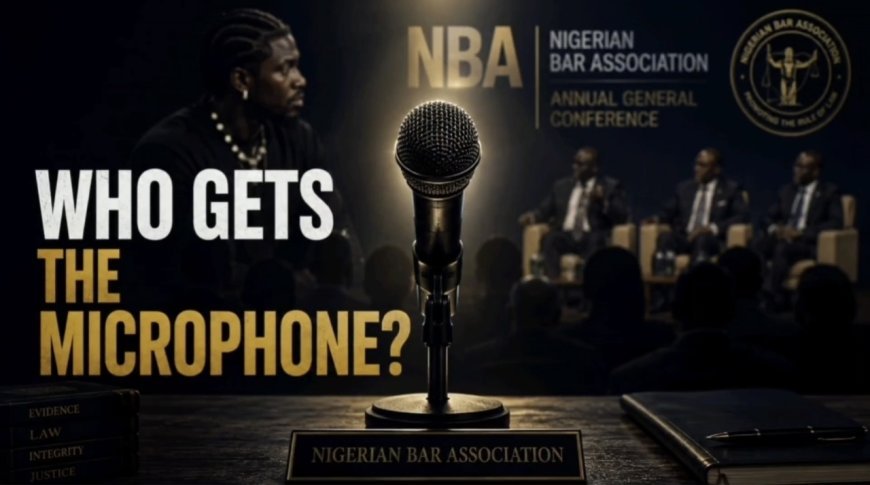
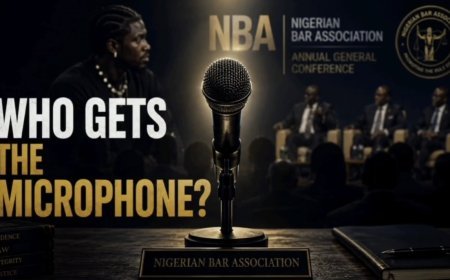
There was something revealing about seeing Martins Vincent Otse, popularly known as VeryDarkMan, seated at one of Nigeria's foremost professional gatherings to discuss insecurity. At the Nigerian Bar Association's Annual General Conference in Port Harcourt, he appeared on a panel provocatively titled "Known Gunmen or Unknown Gunmen."
Reactions split immediately. Some lawyers questioned why a social-media activist had been given such a prominent platform to discuss a complex national-security problem. Others defended the choice, arguing that knowledge isn't the exclusive property of people with impressive titles, and that VDM's time in communities affected by violence gave him something worth hearing. Both positions deserve consideration. But beneath the argument over one man sits a bigger question: when a serious institution convenes a serious national conversation, what determines who gets the microphone?
Perhaps VeryDarkMan isn't the problem. Perhaps he's the mirror. He didn't force his way onto the NBA stage — the association invited him. And he seemed aware of the limits of his role, telling the lawyers: "I'm not here to teach you people law; I'm here to share experience." That distinction matters.
There's nothing inherently wrong with hearing from an activist. Professional conferences shouldn't become gated communities where only degrees and titles earn a seat. Sometimes the people closest to a problem see dimensions of it that officials sitting far from the consequences miss. But experience, advocacy and expertise can overlap without being the same thing.
That was the concern raised by human-rights lawyer Femi Falana, SAN, who questioned VDM's inclusion in such a specialised discussion. Falana wasn't simply objecting to a non-lawyer entering a lawyers' conference — his deeper worry was whether conversations about national security should prioritise people with demonstrable expertise, rather than letting professional gatherings drift toward entertainment and spectacle.
Other critics went further. Lawyer Jiti Ogunye described the episode, in a social-media post, as "Nigerian Bad Association and Very Dark Misconduct," accusing VDM of conducting a media trial over a pending murder charge and calling the whole affair an "emBARrassment."
Ogunye's language is severe, and accepting all of it isn't necessary to confront the institutional question underneath. The issue isn't whether unconventional voices belong in serious national conversations — they do. The issue is whether institutions exercise discernment about who gets a platform, for what subject, and on what strength of knowledge or evidence. Rejecting elitism doesn't require abandoning standards.
VDM's defenders raise a fair counterpoint: expertise doesn't always wear a suit or carry a degree. Someone who has travelled to communities hit by insecurity, spoken to victims, and repeatedly engaged public institutions may hold real experiential knowledge. Nigeria should be wary of confusing credentialism with competence — but equally wary of confusing visibility with expertise.
That distinction sharpened when VDM reportedly alleged that some police officers at checkpoints identify wealthy travellers and pass their details to kidnappers. It's an explosive claim. The Nigeria Police Force rejected it as unsubstantiated and challenged him to produce evidence, saying credible information would be investigated. VDM reportedly maintained he had evidence, but would only present it in court if prosecuted.
Whatever one thinks of either side, one principle should hold: an allegation is not evidence. That doesn't make it false — it means exactly what it says. Until substantiated, it remains an allegation. This isn't pedantry; it's how truth survives scrutiny.
No profession should understand that distinction more instinctively than the legal one. A courtroom doesn't function on the strength of a believable accusation. A case isn't made by showing that a claim matches what society already suspects. Evidence must be produced, tested, and weighed. Eventually the question is simple: can you prove it?
That's why the symbolism of the NBA episode matters. The recognition VDM received shouldn't be read as more than it was — not professional certification as a security expert, but acknowledgment of his participation. Still, institutional symbolism carries weight. Who institutions invite matters. Who they elevate matters. What expertise they place beside what problem — and what they appear to validate in front of an audience — matters too.
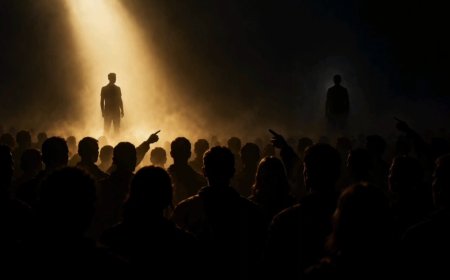
Nigeria has an unusual relationship with visibility. Popularity starts to resemble authority. Followers start to look like qualifications. Virality starts to resemble expertise. The ability to command attention becomes proof, in the public mind, that someone deserves a microphone on almost any subject.
"Popularity starts to resemble authority. Followers start to look like qualifications. Virality starts to resemble expertise."
Social media has genuinely democratised public speech, and much good has come of that — ordinary citizens challenging officials, exposing abuses, forcing conversations institutions would rather avoid. That should be protected. But democratising the microphone should never mean democratising truth. Truth doesn't become true because enough people share it, and expertise doesn't become irrelevant because experts sometimes fail.
"Democratising the microphone should never mean democratising truth."
A better NBA panel might not have excluded VDM at all — it might have placed his experience alongside a criminologist, a security practitioner, a victim of kidnapping or terrorism, an investigative journalist who has covered insecurity for years, and lawyers equipped to examine the constitutional and evidential angles. Experience meeting research. Allegation meeting evidence. Activism meeting institutional knowledge. That isn't elitism — that's depth.
There's a reason this matters beyond one conference. Nigerians are angry, and understandably so: corruption allegations vanish, insecurity persists, institutions fail, powerful people escape accountability. Distrust of authority didn't come from nowhere. But distrust creates its own vulnerability — when people lose faith in institutions, they can start believing almost any accusation against those institutions simply because it sounds plausible. That's dangerous.
A claim shouldn't become credible just because it confirms what we already suspect, and we shouldn't demand proof only from people we dislike. If government makes a claim, ask for evidence. If the police make a claim, ask for evidence. If VeryDarkMan makes a claim, ask for evidence. The standard can't change depending on whose microphone is switched on.
Nigeria needs citizens courageous enough to confront power, and disciplined enough to substantiate serious accusations. It needs activists, whistleblowers, journalists, professionals, experts — and sometimes outsiders who notice what comfortable institutions have stopped seeing. But institutions need the humility to hear unconventional voices, and the discernment to tell popularity apart from competence, testimony apart from expertise, allegation apart from evidence.
The easiest reading of the NBA controversy may also be the least interesting one. It's simple to make this story about VeryDarkMan. It's harder to admit the story might be about us — about a public culture that treats attention as currency, rewards confrontation, and applauds certainty more readily than care. VDM didn't build that culture. He may have just mastered it.
So the lesson here should travel well beyond the NBA. The next time an explosive allegation lands on our screens, the first response shouldn't be applause, outrage, or instant condemnation. It should be three questions: What exactly is the claim? What evidence supports it? Can that evidence survive scrutiny?
Nigeria doesn't need less courage, or quieter citizens, and it certainly doesn't need a return to a society where only elites are permitted to speak. What it needs is harder than either: anger with evidence.
A microphone can amplify a claim. An award can dignify a platform. Applause can validate a speaker. But none of them can turn an allegation into proof. Until we learn that distinction, we'll keep producing the loudest public conversations while wondering why they rarely bring us closer to the truth.
TWOMN Editorial
What's Your Reaction?
 Like
0
Like
0
 Dislike
0
Dislike
0
 Love
0
Love
0
 Funny
0
Funny
0
 Angry
0
Angry
0
 Sad
0
Sad
0
 Wow
0
Wow
0