


























































An Oath Before Relocation: A Question of Trust
A viral relocation story raises uncomfortable questions about trust, sacrifice and dignity between spouses.
Prefer listening? Tap play and the article will be read aloud.
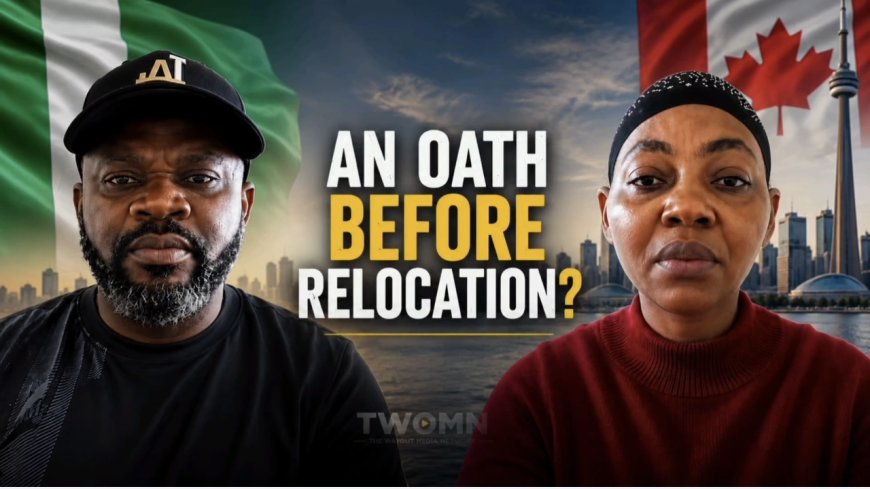
A viral story involving a wife in Canada and her husband in Nigeria has sparked a wider conversation about trust, sacrifice, dignity and the conditions spouses place on one another.
A story involving a Nigerian couple has been generating conversation online. According to the account circulating on social media, the wife is already living in Canada while her husband remains in Nigeria. Before helping to facilitate his relocation, she reportedly asked him to make a video swearing an oath, with serious consequences attached should he eventually disappoint or betray her.
If the account is accurate, it raises an uncomfortable question: how did a marriage reach the point where relocation requires an oath?
There may be history between this husband and wife that the public knows nothing about. We do not know what conversations took place privately, whether trust had previously been broken, or what fears may have informed the wife's decision. A short video or social-media post cannot tell the complete story of a marriage.
For that reason, this should not become an opportunity to condemn the woman or humiliate the man. But it can—and perhaps should—start a wider conversation about marriage and trust.
Marriage requires sacrifice. Sometimes one spouse is financially stronger; sometimes one gets an opportunity abroad before the other. In healthy relationships, circumstances change, and husbands and wives may find themselves carrying different responsibilities at different stages of their lives together.
Relocation itself can put enormous pressure on a marriage. One spouse may suddenly have immigration status, greater earning power or access to opportunities that the other does not yet have. That imbalance can introduce fear: What happens when my spouse arrives? Will the relationship change? Will everything I sacrificed be forgotten?
Those fears may be understandable. But does fear justify requiring your spouse to swear an oath before you help them join you?
There is also an interesting gender question here, although it should be approached carefully. If the situation were reversed and a Nigerian man living in Canada demanded that his wife record herself swearing an oath before he would facilitate her relocation, how would society react?
Would people describe him as a man protecting himself from betrayal? Or would they call the condition controlling, degrading or humiliating?
That hypothetical reversal is worth considering—not because it proves that men sacrifice more than women or vice versa, but because it helps us examine whether we sometimes judge the same behaviour differently depending on whether it comes from a husband or a wife.
What I found particularly uncomfortable about the circulating account was the apparent loss of dignity involved. Whatever difficulties exist between husband and wife, marriage should not become a public contest in which one spouse must demonstrate submission or desperation to the other.
And where children are involved, the stakes become even greater. Marital disagreements no longer concern only two adults; decisions can affect an entire family.
Perhaps the biggest issue, therefore, is not Canada, immigration or even gender.
It is trust.
If you believe your spouse may betray you the moment circumstances improve, there is already a deeper problem requiring attention. An oath may provide emotional reassurance, but it cannot manufacture trust where trust has disappeared. Neither can relocation repair a marriage whose underlying problems remain unresolved.
A healthy marriage is not a marriage without disagreements, fears or difficult seasons. It is one in which both people can confront those difficulties with communication, accountability, mutual respect and a willingness to resolve problems without destroying each other's dignity.
So rather than simply asking whether the wife was right or the husband was wrong, perhaps we should ask a more important question:
If your spouse had the opportunity to help you relocate abroad but demanded that you first record yourself swearing an oath never to betray or disappoint them, would you do it?
And if you felt such an oath was necessary before helping your own spouse, what would that say about the state of your marriage?
The Wayout Media Network (TWOMN)
What's Your Reaction?
 Like
0
Like
0
 Dislike
0
Dislike
0
 Love
0
Love
0
 Funny
0
Funny
0
 Angry
0
Angry
0
 Sad
0
Sad
0
 Wow
0
Wow
0